Education Data with AI Insights
An AI-powered education analytics platform that helps university teams turn complex student data into clear, collaborative decisions.
Role
Lead Designer
Timeline
2023
THE PROBLEM
Higher education institutions are data-rich, but insight-poor.
Raw and fragmented data makes routine analysis slow.
Descriptive dashboards offer little help deciding what to do next.
Insights become separated across meetings and files, weakening collaboration.
THE VISION
I led product design within a six-person cross-functional team. Through focus groups, journey mapping, stakeholder analysis, and literature review, I reframed the brief from building another dashboard to helping education teams understand, discuss, and act on evidence.
Make complex analysis understandable, collaborative, and actionable without requiring data expertise.

01 · Start with the data you have
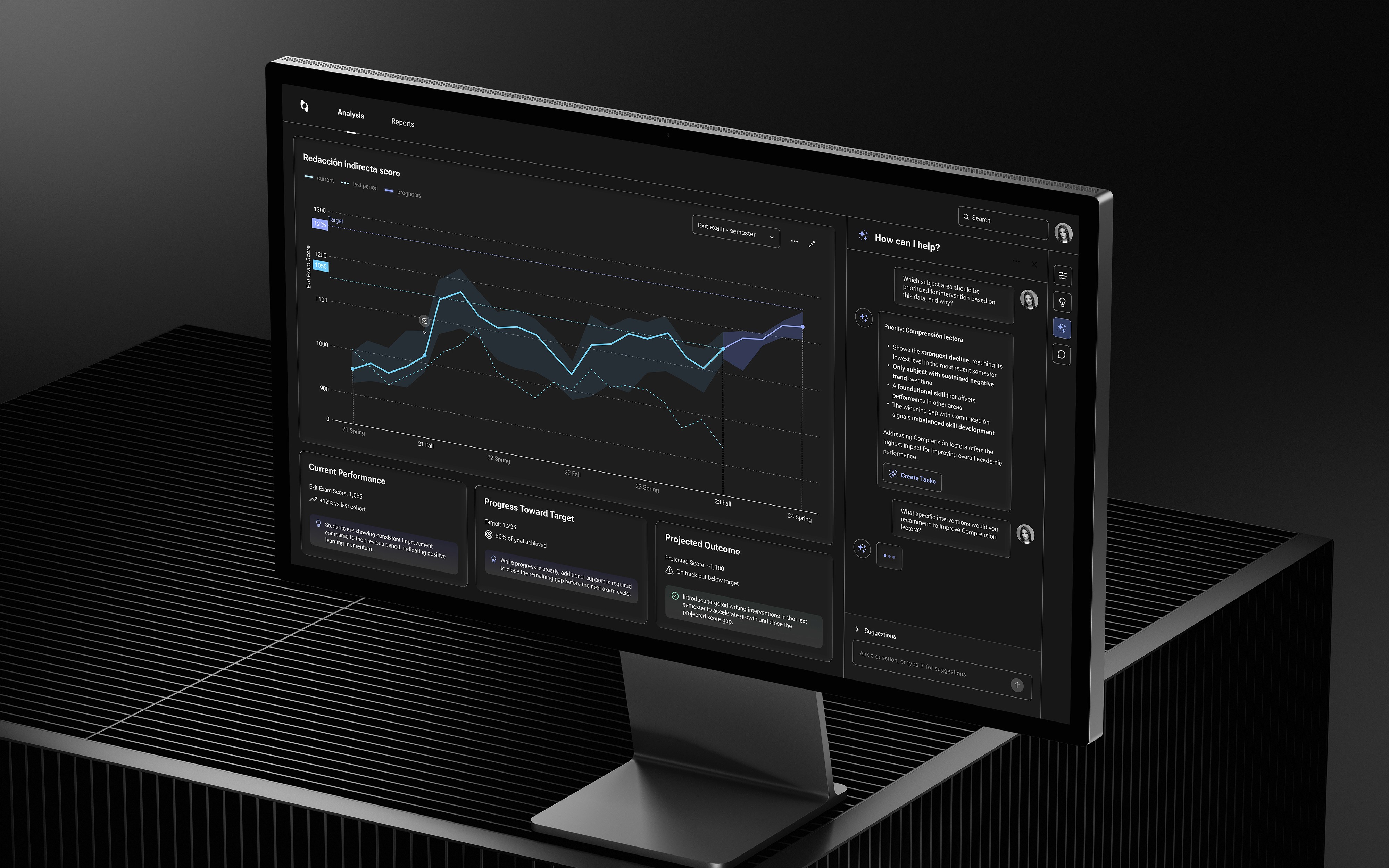
Users can import raw data without technical setup. I designed an education-specific analysis experience that turns complex numbers into interactive visual narratives, pairing each chart with plain-language interpretation so non-technical users can understand what changed and why it matters.


02 · Keep the conversation with the data
I anchored collaboration to evidence: users can annotate specific data points, share insights to Slack, and revisit every discussion in a searchable, timestamped feed. This preserves not only the conclusion, but also who contributed and the context behind the decision.

03 · Make informed decision
I connected campus-level forecasting with an AI-assisted report workflow. Predictive views help teams spot emerging risks; a conversational sidebar then turns selected analyses into an illustrated semester report that users can refine before sharing.
From an open-ended research brief to a working product
We began with a broad challenge, multiple stakeholder groups, and no established product workflow. I defined the experience strategy, information architecture, and core flows, then led four major rounds of prototyping to align education research, data science, and engineering.
To make predictions trustworthy, I partnered with the data team to translate model behavior—not only model output—into product decisions. We compared classical models with a neural network, selected the better-performing Random Forest approach, and identified sparse campus representation as a key limitation for future iterations.
IMPACT
InsightPro+ translated education analytics and predictive modeling into a usable, collaborative product. The final experience earned a 91.7% average pre-launch rating, most campus-level exit-exam predictions fell within ±2.2% of actual scores, and the project received 10+ international design awards.
91.7%
Pre-launch average product evaluation score
±2.2%
Prediction error rate
10+
International design awards